

Dental implants are a highly successful and modern way to permanently replace one or multiple missing teeth. This technique has been developed and perfected over the last 40 years to produce reliable and long-lasting, permanent solutions to tooth loss.
A dental implant is a titanium fixture, usually in the shape of a screw, that is surgically inserted in the jaw bone to permanently replace a missing or hopelessly damaged tooth.
The implant fixture basically serves the function of the tooth root, and serves as a base for the construction and fitting of a crown. In selected cases, a damaged tooth can be removed and replaced with an implant-supported crown in the same day.
Dental implants are made of biocompatible titanium and once inserted into the bone with meticulous surgical technique, start forming a biological bond to bone tissue.
Over the next few months, bone-forming cells adhere to the implant surface in a process called “osseointegration”, essentially becoming part of your body.
Planning stage
Every case is treated individually, and we will assess your specific dental condition and recommend the best treatment approach. The consultation and examination process involves a thorough clinical examination and 3D CT scan to assess your individual condition and needs. We then feed the data from your 3D CT scan into specialised planning software and design the implant placement protocols and positions.
Surgery stage
We administer local anaesthetic to ensure you are completely numb during the surgical phase of treatment. The implants are carefully inserted into the jaw bone in strategic positions and angulations, sometimes using a surgical stent as a guide. In immediate restoration cases, a provisional crown will be fitted immediately. Sutures are then placed around the implant fixtures to facilitate rapid healing.
Final Prosthetic stage
After suitable amount of time to allow for osseointegration and associated soft tissue contouring (average 3 to 6 months), a final crown can now be fitted to the implant fixture
Single tooth implant: Dental implant for your single missing tooth.
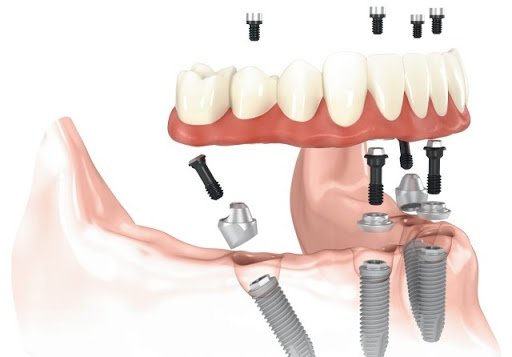

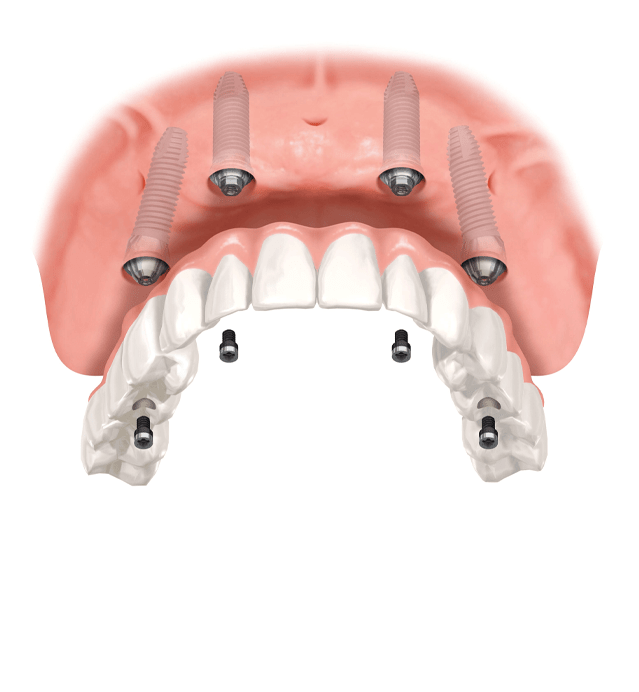
All On 4, aka Same Day Teeth: These are fully fixed set of teeth in a day.
An initial consultation session where we sit down with you and discuss all the treatment options available. We will learn about your treatment goals and discuss what you can expect both before and after the procedure. We’ll answer all of your questions in-depth and to the best of our ability to ensure that you’re comfortable with the process to come and understand what you will experience. We have an incredibly talented and highly experienced team that will guide you through every step of the All On 4 procedure.
The second step of the process is to ensure you are a candidate for treatment. This includes performing a 3D CT scan to assess the condition of your jaw and to check the quantiy and quality of bone. If there is insufficient bone present, we may outline bone growth and grafting options available. We will then plan your treatment using specialised software to determine the optimal position for your implants.
Next is the surgical component of the All On 4 dental implant treatment. To make room for your All On 4 implant bridge, any remaining or deteriorated teeth will be removed and the jawbone will be prepared under local anaesthetic. The All On 4 implants are then precisely placed into the jawbone. The implant sites are sutured closed to heal. A temporary provisional bridge or denture is normally prepared in advance, which will be worn while the implant sites heal and the components integrate into the jawbone. This may vary in time for patients depending on factors such as bone differences and healing rate. An impression of the mouth is also taken which will be used to construct the final All On 4 implant-supported bridge. Once the implants are sufficiently stable, you’ll get your FINAL permanent All On 4 teeth 4-6 months after the initial surgery.
A conventional denture has no attachment to your gums. It relies on suction to stay in place however, during talking and eating, suction is not always enough to prevent it from moving around in your mouth. For many patients following tooth loss, the gums shrink and therefore, there is little hope of achieving sufficient suction to aid any denture stability. Some denture wearers will get used to this problem by adjusting their diet and eating habits. With dental implants, such a sacrifice in your quality of life does not have to be made.
By placing dental implants into the gums, we are able to provide physical retention for the denture. These attachments are called abutments. The abutments ‘CLICK’ into the denture – holding the denture in place very firmly.
Implant supported dentures have many benefits over their conventional counterparts, including:
If you’d like to learn more about implant retained dentures then why not book a consultation at Tenbury Dental Centre.
Why choose Tenbury Dental Centre for implants?
No WhatsApp Number Found!
WhatsApp us